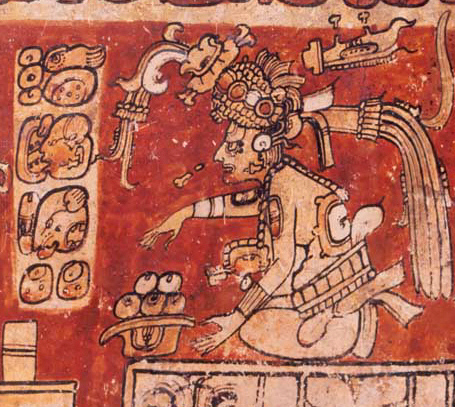
Friday, June 22, 2012

Zipacna and Cabracan.

Two little boys were playing in a sandbox.

The elder boy, Zipacna, was building a huge pile of sand. "Look, Daddy," he said. "I make mountains."

The younger boy, Cabracan, took his shovel, whacked the pile hard and knocked it down. "I break mountains," he said.

Seven Macaw's blue teeth shone as he smiled proudly at his two sons.

"Then that is what you shall be," he said. "Maker-of-Mountains and Breaker-of-Mountains."


**********

More stories about Zipacna and Cabracan:

Zipacna: All the Time in the World.

Cabracan Bites the Dust.

Wednesday, June 20, 2012

Xibalba: The Room of Re-membering, Part 2.

As the ghost sorted through his bones, he began to find bird bones mixed together with his human bones. At first, he was puzzled; but all the bones seemed to belong there, to be part of him.

As he reassembled his human skeleton, he began to put together the bird skeleton, too. He found its skull and beak, its vertebrae, the fine, fragile bones of its wings, and its legs. As the bird took shape, he saw that it was a parrot, a macaw.

Memories came with the bird-bones, too: first, only vague impressions, animalistic feelings; the sensation of movement, of flight, of being guided by instinct. Then, as the parrot's form began to take shape, he got his first clear memory:

Long ago, when both he and the world were young, this bird had come to him, beneath the branches of a marvellous tree. The bird had diamond eyes and plumes as radiant as the rainbow. It had shone its eyes at him, fluttered its beautiful feathers, and it had spoken.

But now, the bird did not move or speak. It lay on the rock, lifeless and inert. The diamonds were gone from its eyes; there were just empty sockets in its skull.

The ghost searched for the diamonds, looking everywhere, in the dirt, under rocks. Finally, he found one tiny, broken piece of diamond. He held it in his skeletal hand, puzzled, wondering what it meant.

Then, he remembered something he had learned as a miner: Only diamond can cut diamond.

All at once, he knew what it signified: He, and only he, was responsible for the bird's destruction. Whatever other factors had been involved, his own choices had brought about its final demise.

"I'm sorry," he whispered to the bird-spirit. "I'm sorry that I failed you." But the bird did not answer. It was dead -- far more dead, perhaps, than the ghost himself.

Sitting on his rock, the ghost held the dead bird's remains to what was left of himself, and he cried for a long time.

Nonetheless, the bird's bones were still his; they belonged to him. And, although the little skeleton was now nothing more than a symbol of despair, he couldn't bear to leave it behind. So, when he had finished assembling the skeletal macaw, he hung it inside his rib cage, so he could carry it with him, inside him.

The ghost continued his work of rebuilding himself. As he put together his legs, he gained memories of walking and climbing, of wandering through the world. There was something strange about these memories: he seemed to have seen too many places, done too many things, for the life of just one person. He wondered, perhaps, if he was just recalling stories he had heard of other people' lives. But that could not be true, for the figure in the scenes who moved and acted was always himself.

And, lastly, he put together his feet, adding each tiny bone until all ten of his toes were complete. His feet gave him knowledge of dancing. He danced, sometimes alone, sometimes with a woman. He still didn't see her face; he was only aware of her body, her movements, her long black hair floating around her like wings.

When his skeleton was whole, his spirit-energy began to knit together around it. As the ectoplasm folded itself into place, closing over his frame, it began to take on a darker hue, an echo of the rich coppery brown of his living skin. A ghostly cascade of jet-black hair draped to his shoulders, wispy as spider-silk. He reached back and knotted it into a ponytail.

Well, he thought, I am now as close to being myself again as I can be for now.

He still did not know who he was, but he knew some things about himself: He was a miner; he had dug precious things out of the dark earth. He had created things of beauty. He was a man of knowledge, a scholar. He had travelled all over the world, in search of its wonders and marvels. He had danced, he had flown, and he had loved. He had raised children.

But he also knew two other things:

First, he had terrible enemies. The Twins, the one who had tortured him, had power over time. Somehow, they had actually changed the way time worked. He didn't understand it; he only felt horror that such merciless forces existed in the world. And he knew that those two were not his only enemies.

And, second, through some act of folly, he had let what was most precious to him die. Therefore, he was truly one of the accursed.

Nonetheless, he began to move his creaky bones, stretching himself, swinging his arms and legs. While he limbered himself, he thought: What's done is done. I have regained my ability to move, speak and act; I will never give that up again. Those are my treasures now.

And so he got up from the rock, and set off across the barren landscape of Xibalba.

Sunday, June 17, 2012

Xibalba: The Room of Re-membering, Part 1.

He was only a pile of white bones, lying on the dry, dusty ground.

He could not move nor speak nor think. He simply lay there, a scattered heap of bones, motionless, except when the wind occasionally rattled and rolled them in the dust.

Time went on; perhaps days or months or years passed by in the world of the living, while the little ghost's spectral skeleton lay broken and inert on the desolate plain of Xibalba.

Finally -- after how long, he could not tell -- the ghost began to awaken to himself, becoming vaguely aware that he was lying there in the dust. He became aware that he was no longer in one piece. His skull lay alone, on top of a rock, with the rest of his bones strewn around it in the dirt.

He was nothing but a pile of dead bones, inert and motionless. But he began again to feel. He ached and yearned to move again. He yearned to move and speak. He ached so much he could not bear it.

So, he began to look for his pieces, to put them back together. First, he felt the round shape of his skull, enclosing what was left of his mind. His skull had no eyes, ears, or other sense organs, but he could see and hear with his spirit senses. He realized that his skull was not whole; the lower jaw was missing.

The ghost reached out with his spirit-senses to search the space around him. He found the jawbone lying on the ground a few feet away. He sent out a wispy, luminous filament of spirit-energy to draw it back to him -- but the moment his spirit touched the jawbone, he recoiled. The jaw was nothing but clean, dry bone, but its touch brought forth a hideous memory: something putrid, honeycombed with worms and pus, with the foul taste of rotting bone and pulp. Accompanying this loathesome image was a sensation of unbearable pain, throbbing, aching, burning; a sickening feeling of nausea and fever.

That jawbone was the very last thing that the ghost ever wanted to touch. But he knew that if he didn't put it back on, he'd never speak again. And he didn't want to go through all eternity without being able to talk.

So, he curled a luminous fiber of energy around the bone, and, slowly, bit by bit, began to tug it back towards him. With each inch that he moved it, more agonizing sensations filled his awareness. The ghost wanted to scream, but without a mouth, he couldn't make a sound.

Finally, he succeeded in moving the lower jaw into its proper position. Steeling himself, he popped the hinges of the jaw back into place.

Instantly, as the joint snapped back together, a terrifying memory erupted in his mind:

He was falling from an immense height, from a tree with green leaves. The blue sky was rushing away upward; the wind was roaring past him like a hurricane. Then, the ground struck him from beneath like an earthquake.  It seemed like the whole world around him was smashed, shattered, flattened by the terrible impact. He lay crushed, motionless, in agony beyond imagining.

It took the ghost a while to recover from the shock. He knew that what he had just seen and felt was impossible. Surely, nothing mortal could have survived such a fall to see or feel anything at all afterwards. And, if he was not mortal, what was he doing here in Xibalba?

But, his confusion had to remain unresolved for now. He tested his jaw, clacking it open and shut. He could make his mouth move as if he were talking, but he still had no words. He realized that he still had to find his teeth.

Again, he sent out his senses to search. His teeth were all scattered about, lying in the dust, or underneath rocks, or jumbled amidst his other bones. One by one, he picked them out from where they were hidden and drew them back to his mouth, setting each into its proper place. As each tooth went in, there was a stabbing jolt of pain, like a tooth being pulled, but in reverse. The teeth were just plain, white bone, but mixed together with the feelings came flashes of color, green, blue, aquamarine and turquoise, and strange hieroglyphic symbols. He saw the blue sky, the clouds.

As his teeth went back into place, his powers of language and reason also returned to him. His thoughts, which had previously been just swirling images, began to shape themselves into clear words. He was able to name and describe what he felt. He still hurt terribly, but his fear was eased, because the words gave him power and control over his experience.

Finally, his head was complete. He took a little time to savor his achievement: a polished, white skull perched on a rock like a throne, surrounded by the rest of himself. Then, he began to put together the remainder of his skeleton. With his wispy, coiling tendrils of ghost-mist, he found the bone pieces, one by one, and put them back where they belonged: the vertebrae of his neck, the sockets and blades of his shoulders, the long column of his back. As each piece was reattached, flashes of memory came with it, shards of visions and feelings.

As he put together the long bones of his arms, he saw himself standing in a cave, a mine, swinging a tool with powerful strokes, as he dug shining metals, crystals and gems out of the dark earth. From the bones of his hands, he received the feelings of touching a woman's flesh; the touch was tender and gentle, and the memory filled him with an inexpressible yearning and longing. With his fingers came the sensations of holding a stylus and quill pen, of writing and drawing, of skillfully making things. And his spine gave him the knowledge of carrying children on his back, lifting them on his shoulders, holding them up so they could see the moon and the sunrise.

[To be continued.]

Friday, June 15, 2012

Xibalba: The Room of Winding.

The ghost stepped toward the next door of black obsidian. There was an ominous sound coming from behind the door: a sound of creaking and grinding, the screeching of metal. The ghost knew that whatever was behind that door wouldn't be very pleasant. For a moment, he wondered: Why? What have I done to deserve this kind of afterlife? But he knew there was only one way to find out; and it lay through that door, and all the other doors that followed. So he gritted his teeth, opened the door, and quickly stepped in before he had time for second thoughts.

Immdiately, he was seized by two giant figures, twins, one dressed in gold and radiating golden light, the other dressed in silver and shining with pale light. He did not know who the twins were; he only knew that they were his enemies.

The Twins laughed and gloated over him. "You are ours!" they cried. "It is our time now; we own the days and years, and you shall be broken on our wheels."

"You are only demons," the ghost said angrily. "You are surely no more than the other fiends in the pits of Xibalba."

"We will show you what we are," the Twins replied. They took the ghost high up into the night sky, where he could see the universe.

All the cosmos had become one great clockwork. The ghost had never seen so many wheels in one place. Everywhere there were gears gripping other gears in their iron teeth, wheels spinning on axles, turning and turning. All around there was measure and motion: millions of legs marching in unison, clocks ticking and ringing, bells clanging and dinging, pendulums swinging, everything going round and round.

The ghost saw people's lives regulated by the clock and calendar, getting up and going to sleep at the appointed hour, going to work and punching time clocks, factory whistles shrilling, rows and rows of people standing at assembly lines which kept rolling and rolling.

It was a new world, a new universe, in which everything was timed and tuned and regulated, everything moving in order.

"The Fourth Age is on its way," said the gold twin, "and it shall be built by the breaking of your body."

"Never!" cried the ghost. He struggled to escape, but he was like no more than a tiny bird caught in the two giants' hands. They only laughed at his desperate attempts to get away, toying with him for a while before they got down to business.

Then, the Twins began the great ritual. They stretched the ghost out, one taking hold of his hand, the other his foot. Holding him suspended over the celestial mechanism, they chanted an incantation:

Your time is over,
Our time has come.
We are now the Moon and Sun;
The time of Measure has begun.

The age of rhythms and cycles;
The time of straight lines and circles.

The time of Euclid and Newton,
The age of wheels and axles,
The time of pistons and crankshafts,
The age of the turning engines.

We are the glory of monarchs,
The splendor of civilization;
The age of flags and armies,
The time of states and nations.

Hail the age unfolding,
Hail the turning spiral!

Now we are arising in brightness,
Now is our time of morning.

And so the Twins put the little spirit on their iron wheels; they wound and unwound him. They stretched him out and knotted him up. They spun him on a spindle, turned him on a lathe, roasted him on a spit, stretched him on a rack. They spun him out like thread, like wire; they wound him up like yarn, like a clock.

The ghost screamed and screamed. He could do little else. He was only a powerless shade, while the Twins were the harbingers of an inexorable power.

They pulled him tight and taut, stretching and tearing and twisting, until all his tendons and ligaments snapped, and he was broken apart. They ripped his ectoplasmic flesh from his spectral bones. They pulled him apart until he was nothing but a heap of disconnected pieces, a pile of scattered bones.

When they were finished, they left him lying, a pile of dry, bare bones, on the dusty ground.

Tuesday, June 12, 2012

The Cave of Vision.

[Early Third Age. This is Seven's first encounter with Itzamna, the Pre-Classic deity believed by many scholars to be a mythic precursor of Seven Macaw.]

Seven Macaw walked into the dark cave, lighting his way with a single candle. He found the room he was looking for, where stalactites and stalagmites projected from the roof and floor of the cave like teeth, resembling a giant maw. Setting the candle on a natural pedestal of stone, Seven Macaw sat down cross-legged between the giant teeth of the stone monster.

After taking some time to settle and quiet himself, he took the bag he had brought with him, and pulled out a piece of nance fruit. He put the rest of the fruit in a bowl, and placed it on the stone pedestal as an offering to the spirit of the cave.

Taking the remaining piece of fruit in his hand, he closed his eyes, softly murmuring the verses he had composed. Then, he brought the fruit to his lips, and bit into it. The sweet juice burst into his mouth; he chewed and swallowed, affirming that he would accept whatever sights or knowledge came to him, whether it be beautiful or horrible. Sitting quietly in the stillness, amid the stone teeth, he waited for the visions to begin.

Soon, the young man's sight began to alter. He saw his own face reflected against the stalactites and stalagmites of the cave, reflected many times, and broken into splinters. As he watched, the scattered pieces of images coalesced, and shaped into another face, that of an ancient man, older than the mountain itself. The man's shape took form amid the dark cave shadows.


The old man's face was perfectly calm, neutral, without a trace of judgement, blame or disturbance, as if he could gaze unmoved upon all of creation. "Greetings, little bird-spirit," he said. "I am Itzamna, First Shaman of the First Age, as you are of the Third." He held up a single finger. "You may ask one question. What do you want to know?"

"I want to know how to become immortal," replied Seven Macaw.

Itzamna showed neither anger nor sorrow, but his imperturbable calm shifted slightly, with what might have been compassion. "You do not know what you ask, little one."

"I want it, nonetheless," said Seven Macaw boldly.

"The price of life is death. The price of immortality is something greater than death," said Itzamna. He spoke the words simply; neither a warning nor a threat, just a fact. "Do you still want it?"

"Yes," said Seven Macaw.

"Very well," said Itzamna."Look within these caves, within the earth, and you will find the tools to make your immortality."

And Seven Macaw's vision was opened, and he saw into the walls of the cave, into the heart of the mountain. He saw where the secret veins of precious metal were hidden, and the jewels and gems. And he glimpsed too the powers within these things, and how they might be forged and shaped into instruments of magical transcendence and transformation.

After Seven Macaw had seen all he needed, he came back into his body.The candle was nearly burned down. The bowl of fruit was also empty, even though he hadn't seen Itzamna take any of it. Seven Macaw smiled a bit. "I hope you like it, Itzamna," he whispered.

Then, he carefully took the candle, and headed back to the exit of the cave, where he slipped outside into the darkness of the day-night. The first light of dawn was just beginning to kindle on the eastern rim of the sky-earth. He knew he still had much to learn, and much work to do.

Thursday, June 7, 2012

A Bit o' Mayan Awesomeness: Seven Macaw versus the Hero Twins on a Plate.

Click to see larger version.
Here's something I just found: a surrealistic, psychedelic depiction of Seven Macaw/ Vucub Caquix's fight with the Hero Twins, from a Late Classic Maya polychrome plate. (Found here). I love the way it shows Seven's defiance and his overall weirdness.

Here, Seven is getting shot at from both sides, but he's fighting back proudly, using the powers of the cosmos which he controls. I just love that expression on his face: sort of like, "Just you try and get me!"

In this picture, Seven is perched not on an ordinary tree, but on a giant head with an elaborate rayed, petaled or plumed crown, which, I think, represents the "false" Sun-Moon of Seven's creation. Hunahpu and Xbalanque are seated on the "real" Sun and Moon.

Here, Vucub-Caquix has shapeshifted into a hybrid form, a bird with a mainly-human head. This picture illustrates one of the puzzling features of the Seven Macaw character: the fact that he is described in the Popol Vuh as having both a bird's beak and human teeth. He also appears to have a Cosmic Serpent entity sprouting from the top of his head, like a jack-in-the-box. The seven vertebrae in the serpent's neck may represent the seven stars in the Big Dipper. In Mayan art, the Cosmic Serpent is often shown associated with the Itzam-Yeh or Vucub-Caquix character, sometimes entwined around him and/or his tree. In these representations, he may be an ally, or an aspect of the Bird Deity himself.

In this image, the serpent on Seven Macaw's head is disgorging the night sky, filled with stars and constellations, from his mouth. This symbolizes how Vucub-Caquix is wielding the power of the cosmos against Hunahpu to prevent him from ascending as the new Sun God. There's also a stream of blood flowing from the serpent's lower jaw, showing that he's already been shot by Hunahpu. Hunahpu has struck Seven Macaw not on his human face but on the serpent's head -- meaning that he has attacked and injured the part of Seven which contains his divine power. That is why Seven is unable to heal & regenerate himself after this injury.

It's the beginning of the end for Seven, but he still doesn't seem the slightest bit intimidated.

The fish (left and right of the center figure) are symbols of the Hero Twins, who have the power to shapeshift into fish (unlike Seven, who can't turn into a fish -- something which will cause him a lot of trouble when he gets hurled into the Cosmic Ocean later in my narrative.) The fish are swimming toward the right, the direction from which the new creation will emerge.

The Twins, as a dyad, are also right-oriented. Hunahpu, the Sun-twin, typically takes the role of leader & initiator. He is facing toward the right as he directly confronts Seven Macaw. Xbalanque is facing in the opposite direction, shooting Seven from behind. As the Moon-twin, he plays the role of Hunahpu's satellite, reflecting back his energy & activity. They're trying to turn the universe around in the direction they think it should go.

If you look closely, you can see that Seven Macaw's symbols (such as the double-curlicues around the rim, which give me the impression of replicating the dragon-serpent motif) are all oriented toward the left, the direction toward which he also faces, resisting the linear, forward movement which the Hero Twins seek to impose on him.

I think this picture is saying that Hunahpu and Xbalanque are destroying not just Seven Macaw/ Vucub-Caquix himself, but the entire Third Age cosmos of which he is the etal: the sign, example or representative.

Another interesting thing is that this picture was originally on a plate. Was the plate intended to be purely decorative, or did people actually eat off of it? I can just imagine it: "Finish up your veggies, Junior, so you can see the really weird birdie on the bottom of the dish."

Sunday, June 3, 2012

Cabracan Bites the Dust.

[This story takes place in the time period after the death of Seven Macaw and before the Flood. It follows the Popol Vuh plotline closely, with additional descriptive detail and character development. Contains profanity.]

Cabracan was very alone in the world now. Not only were both his parents gone, but he hadn't seen or heard from his brother Zipacna for a long time. No one that Cabracan had met knew what had happened to him. It was as if he had vanished off the face of the earth.

The world was very dark now that the Sun and Moon had died. At the times of day-night when the sky turned pitch-black, his father's sign, the Big Dipper, hung low over the horizon, upside-down, its bowl turned over as if about to pour rain on the world. Cabracan still felt a pang of grief every time he saw it.

Cabracan couldn't stop the hurricane alone; the storm kept coming closer, slowly, as if to mock and torture the world's people with their impending doom. For the first time in his life, Cabracan was afraid.

Then, one day-night, as Cabracan walked down the road alone, two young men, just in their late teens, came out of the forest.

"Hello," said Cabracan, with a good-natured smile. "I'm Cabracan."

"Hello, Cabracan," said one of the two boys. "I'm Juan, and this is my brother Jose." The other boy nodded. The boys were almost exactly the same height. Juan stood slightly in front, a bright, mischievous smile beaming on his face, while Jose stayed a few paces behind, looking quiet and thoughtful.

"Nice to meet you," said Cabracan. He looked the pair over curiously. "Which one of you is older?" he asked.

"Neither," said Juan. "We're twins." Jose nodded, and asked, "What about you, Cabracan? Are you all by yourself?"

"Yes," Cabracan nodded sadly. "All I've got is one brother, and I haven't heard from him in a long time. I'm worried about him."

"Well, why don't you come wifh us?" said Juan. "Jose and I travel a lot. Maybe we can help you find your brother."

"Okay," Cabracan nodded. He joined the pair, and smiled. "Thank you. It's good of you to help."

"No problem," said Juan. They walked along together for a while, and Juan asked, "So what do you like to do, Cabracan?"

"I break mountains," said Cabracan proudly.

"Really?" asked Juan. "Can you really break mountains?"

"Sure I can," said Cabracan. "Just watch!" He stretched up, and made himself grow really tall, like a giant. Then he hopped on top of a nearby mountain, and tapped his foot a few times. Rocks began to tumble and roll down the mountainside. The whole slope slipped down like a landslide.

Juan and Jose clapped their hands, applauding. "Wow," said Juan. "That's amazing. Really impressive, Cabracan."

"Yeah," said Jose. "I've never seen anyone do that before."

Cabracan beamed happily. "I'm the only one who can." Then he hopped down from the mountain and returned to normal size as he rejoined the twins.

"You look like the kind of person we've been wanting to meet," said Juan. "Jose and I like sports a lot, too." Jose nodded.

"Oh? What do you do?" asked Cabracan.

"We play ball and we hunt," said Juan. "This is what we hunt with." He pulled out his blowgun to show Cabracan.

Cabracan watched as Juan showed off his weapon. "Are you any good at it?" he asked.

"My brother Juan is the best there is," said Jose. "He can hit things no one else can."

"Wow. Could you show me?" asked Cabracan.

"I'm sure I will," Juan nodded, "once we find a suitable target."

So they continued along the road. "You know, Cabracan," said Juan, "we just saw a really huge mountain the last day-night. It was just humongous."

"Yes, it was," nodded Jose.

Juan continued, "I bet even you couldn't knock it down, Cabracan."

"I bet I could!" replied Cabracan, planting his hands on his hips. "Where is it? Can you show me?"

"Sure!" said Juan. "Just follow us, Cabracan." And he and Jose led Cabracan off the road, into the mountains, where no one would see them.

Afer they had walked through the rocky foothills for a while, Juan said, "Are you hungry, Cabracan? Let's get something to eat." He and Jose pulled out their blowguns, and went hunting for wild quetzal, while Cabracan tagged along. To Cabracan's amazement, the two boys shot the birds without using darts or pellets. They just blew air, and the birds fell down.

"Wow, that really is amazing!" said Cabracan. "Thanks for showing me. You really are cool guys."

"Anything for a friend," said Juan. "Now, Jose and I are going to cook these birds. Why don't you go in the forest, Cabracan, and look for some fruit and vegetables to go with them?"

Cabracan nodded, and went off to forage in the woods. He was very happy to have found his two new friends. Juan and Jose were such great guys -- they really knew how to have fun. Cabracan needed some fun in his life now; he hadn't had any for a very long time.

Meanwhile, while Cabracan was away, Juan and Jose dug up gypsum and plaster from the earth, and coated one of the birds with it. Then they roasted the birds over a spit.

Finally, Cabracan came back from the woods with a bag of fresh vegetables and fruit. They all sat down around the campfire to eat.

"This roast fowl is really good, Juan," remarked Cabracan. "What did you put in it?'

"Oh, just a secret ingredient," said Juan. "Come on, let's go and look for that mountain." So the three got up and went walking again.

But, before they had gone very far, Cabracan began to feel very strange. First his arms and legs became weak and numb; then, his stomach began to hurt. Soon, it was aching terribly, like he'd just swallowed a whole pile of rocks.

"Juan, Jose -- I think something's wrong with me," Cabracan said. "I don't feel well." He sank down weakly to the ground.

"Aww," said Juan. "Maybe something you ate didn't agree with you."

Lying helplessly on the ground, Cabracan held out his hand to his two friends. "Help me, please."

"Sure, we'll help you, Cabracan," said Juan. "Won't we, Jose?" Jose nodded. The two boys opened their packs, and took out some rope. They began to tie up Cabracan's wrists and ankles.

"Please, don't," said Cabracan. "If you want my money, you can take it."

"This isn't about money, Cabracan," said Juan. He looked at Jose. "What do you think, should we hogtie him?"

"Good idea," said Jose.

The two boys bent Cabracan's weakened body backwards, like an arch, and then they tied his wrists to his ankles. Soon, Cabracan's back was beginning to ache just like his stomach.

Sandwiched between twin sheets of pain, front and back, Cabracan gasped and cried out. "Why?" he asked. "Why are you doing this to me?"

Juan leaned against a tree. "Let's just say we've got a score to settle," he said. Beside him, Jose took a shovel and began to dig.

Lying on the ground, hogtied, Cabracan craned his neck, trying to look up at the two boys. It was hard to see their faces from where he was. "You work for Hurucan," he said.

"Wow, this kid is a bright one," Juan smirked. He reached into his pack and pulled out a cigar.

"Yeah, he must be related to the sun god or something," said Jose. His shovel thudded in he ground as he tossed up piles of dirt.

The two boys laughed mockingly. Juan reached into his pack again, and took out a brilliant scarlet feather. He stroked the end of the feather, and a bright, radiant flame burst out of it. The feather burned without being consumed. Juan used the flame to light his cigar.

When Cabracan saw that, he felt even more sick than he was already. He knew where that feather had come from. And, now, he knew exactly who his two "friends" really were.

Cabracan knew the whole story -- he'd heard it from his brother, who'd heard it from someone who had been there in the great city. These same two people, these twins, had shot Cabracan's father, Seven Macaw, with a dart. Seven Macaw hadn't let anyone take the dart out because he was too angry, and he'd gotten very sick -- as sick as Cabracan was now. Then, these twins came back, disguised as friendly strangers. They promised to help Seven Macaw -- and what had they done to him? What had they done?

Cabracan knew, now, that it would be no good begging the twins for mercy, or trying to talk to them. They weren't people who could be reasoned with. They were just enemies, nothing more.

Cabracan's father had held out his hand to these two, and said, "Take pity on me." And what had happened to him?

Now, Cabracan knew that he, too, had been just as naive as his father. He had fallen into the same trap, and now he was paying the same price. But his father had also been brave; and now Cabracan had to be brave, too.

For all of his life, Cabracan had been just a boy -- but now, he was going to die like a man.

Cabracan set his face into an expression of cold defiance and contempt. He would not beg for mercy, nor cry before his foes. He made himself hard as wood, cold as stone. He became firm, stiff, unbending, with a wooden person's unbreakable pride.

Jose jumped out of the deep hole he had dug. "Okay, let's pitch him in," he said. He and Juan picked up Cabracan's hard, wooden form and tossed him in the hole.

"Goodbye, Cabracan," they called mockingly. "Goodbye, little friend."

"Fuck you," said Cabracan.

And they piled the earth on top of him, and he was buried in the ground, along with his bitter, hard-won wisdom. But Cabracan did not die, for he was one of those condemned by Hurucan to be among the more-than-dead: to become a lifeless, motionless object, turned into stone, into petrified wood. But it is said that at times Cabracan manages to regain his power of movement, and then he struggles to escape. And that is what causes earthquakes.